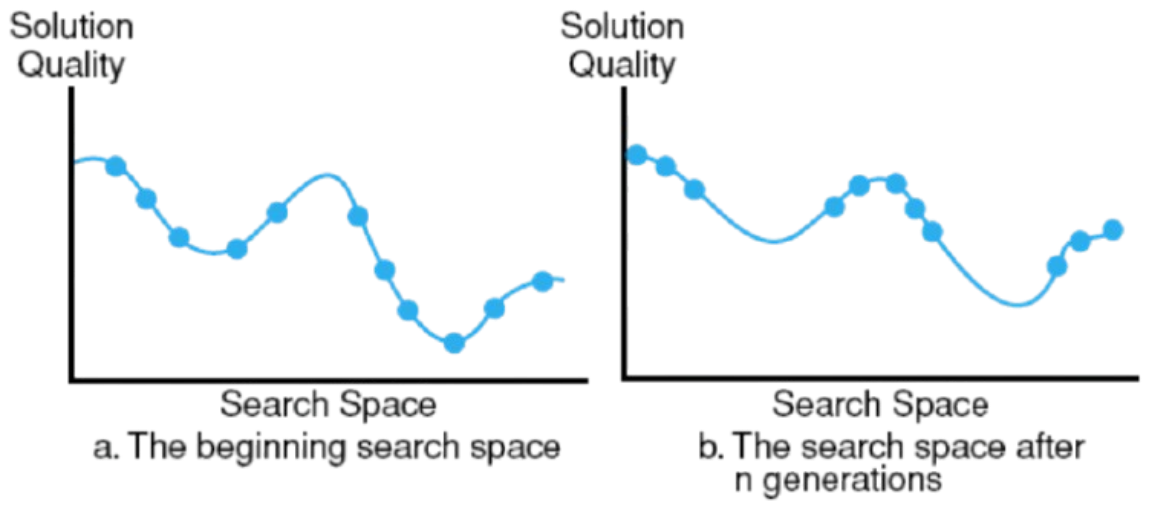
Genetic algorithms sample solution space and guide search where probability of better solutions is larger using competition of agents
- Population size: large slow computation, small not enough agents (normally 20 - few thousand agents)
- Selection method - probability of performing crossover (normally ~) / mutation (normally ~)
- Stopping criteria (eg. number of generations, target fitness, availability of computational resources, …)
Pros:
- faster searching of large search spaces with many local extremes, parallelization of population simulations
- easy algorithm after defining representation and fitness function
- no specialized methods (for given problem) / having just fitness information (cannot compute gradients)
Cons:
- randomized not optimal, can still get stuck on local maxima with possible (over)specialization for local extremes
- non-accurate abstraction of real environment
Evolutionary program template
- Generate population of agents
- Loop while condition is not satisfied (eg. leaderboard updated for some time / …)
- Compute fitness (quality) of agents (fitness must be fast-computable)
- Select candidates for reproduction using calculated fitness (with probability distribution)
- Create new agents by combining the candidates
- Replace old agents with new ones
Gene representation
Define:
- data structure: bit vector / numeric vector / string / tree
- crossover operation: single point / multipoint
- mutuation operation: single point / multipoint
- fitness function determining agents to reproduce - keeping the good, but preventing premature convergence
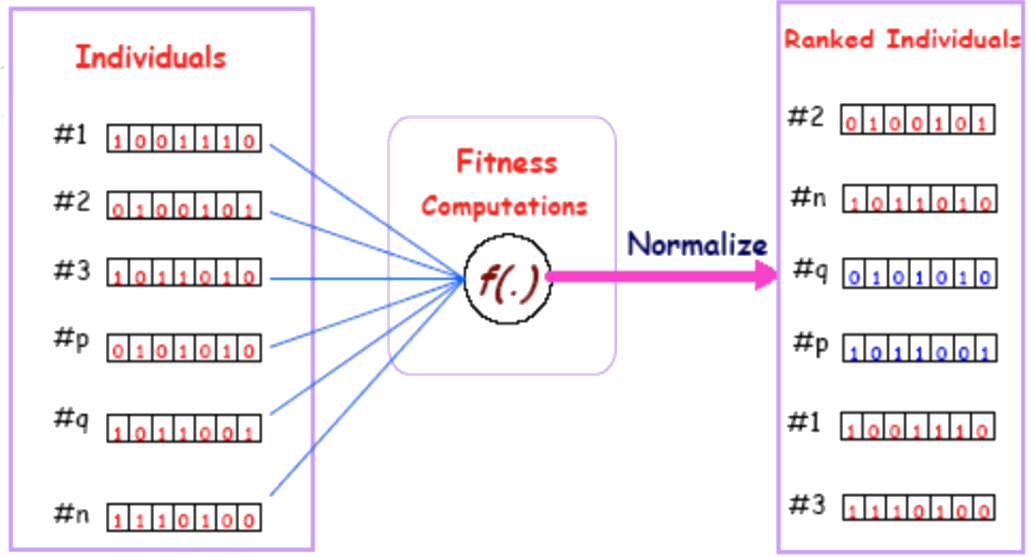
Bit vector representation
Crossover operation:
- Exchange representations over random splitting point
Parents: [1 1 | 0 1], [1 0 | 1 0]
Children: [1 1 | 1 0], [1 0 | 0 1]Mutation operation:
- Flip bits with random probability (larger leads to random search)
Parent: 0110
Child: 0010- Lamarckian mutation: searching for locally best mutation
Numeric vector representation
Crossover operation:
- Exchange representations over random splitting point
Parents: [1.2 | 3.4], [5.6 | 7.8]
Children: [1.2 | 7.8], [5.6 | 3.4]Linear crossover operation: ,
Example: , parents [5 1 2 10] and [2 8 4 5]
Result of crossover: [3.75+0.5 0.75+2 1.5+1 7.5+1.25]
Vartiation for [0.5 0.25 0.75 0.5]: [2.5+1 0.25+6 …]Mutation operation:
- Replace random dimension with random number
- Gaussian mutation:
- Differential evolution
Tree representation
Crossover operation:
- Ordered crossover: choose random path slice, keep it as is and fill with other parent (replace duplicates with missing)
Parents: [1 9 2 | 4 6 5 7 | 8 3], [4 5 9 | 1 8 7 6 | 2 3]
Children: [2 3 9 | 4 6 5 7 | 1 8], [3 9 2 | 1 8 7 6 | 4 5]Mutation operation:
- Switch nodes in path
Neural networks: Evolving neurons, weights and topology of neural network
Selection
Multiobjective optimization problems: fitness function with several parameters
- Pareto optimal solution: no possible improvement of one criteria without getting worse on others
Proportional selection
Each agent has a probability of being selected based on fitness:
Choose slot with random generated number
Rank proportional selection
Each agent is given a rank based on fitness and then a probability of being selected based on the rank:
Tournament selection
Randomly select … size of tournament agents:
- the best among them wins tournament with probability
- else the second best wins with probability
- else the third best wins with probability
Single tournament selection
Split the population into groups of size
The best two win and reproduce, the children replace the worst two in a group
Replacement
Replacement of:
- all agents
- only worst ones
- elitism: keeping the top agents of population - prevent losing good genes
- local elitism: children replace parents if they are better