Often for a single application, low price, highly reliable, resource efficiency
Embedded system pipeline

Intellectual Property Core (IP Core): Reusable unit of logic/functionality (eg. network / video / bus protocol / … chip) produced in high volume
Field-Programmable Gate Array (FPGA): Reconfigurable/programmable integrated circuit for specific functionality better performance
MicroController Unit (MCU): Scaled-down microprocessor sending/receiving commands to connected components needs to be programmed
Sensors: Measure physical properties - convert them to electric signals
- Specifications: accuracy, sensitivity, sensing range, sampling interval, type (digital / analogue)
Actuators: Cause events to occur in the environment
- Driven by embedded system’s signals, often require extra power
Conversions
Analogue-Digital Converter (ADC)
Analogue input (eg. sensor) digital output
Limited number of bits quantization error:
ADC sampling rate - frequency of conversion and sending data - needs to be high enough
Digital-Analogue Converter (DAC)
Digital input (from processor) analogue output (eg. actuator)
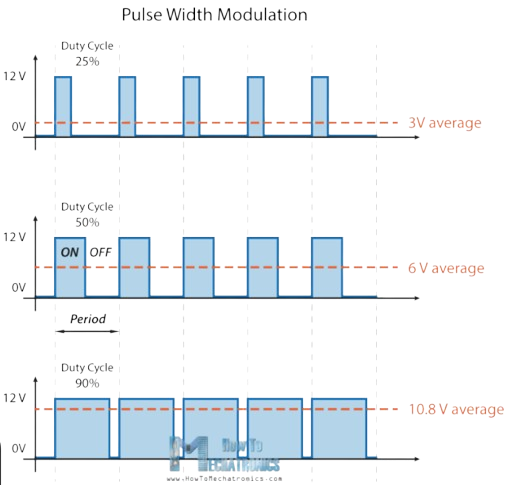
Pulse-Width Modulation: simulating analogue output
Designing Embedded System Applications
Selecting hardware
Datasheets for complex components
MCU selection based on requirements: word length, clock speed, IO pins, timers, …
- storage (cost vs speed tradeoff)
- registers (fast, single location)
- register file (a set of registers)
- memory:
- cache: fast, cheaper than registers (used for data and instruction cache)
- main memory: connected to CPU via bus slow but large
- EEPROM: survives power off, but small and slow (used for configuration data)
- flash: large, faster reads but slower writes than EEPROM, survives power off
Programming MCU
MCU (machine language) vs programmer (high level language)
- Cross compilation: programme on PC, deploy to MCU
- Toolchain: development tools
Embedded operating systems
Communication, managing tasks/processes and resource allocation
Process: abstraction of processing tasks, usually 1 process per app
- Separate memory space slower inter-process communication
Task: smallest unit of execution, multiple tasks per process - fast switching
- Shared memory space direct inter-task communication (shared variables)
OS is optional: embedded devices are often single-purpose
- consumes resources (processing, memory, energy)
OS is useful:
- easier programming and deployment (provides libraries)
- task-resource allocation support (for complex apps)
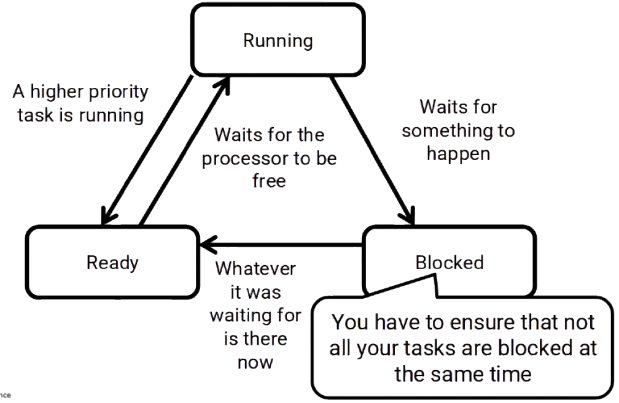
Real-Time Operating System (RTOS): event driven OS with a scheduler for time sharing (eg. round-robin / priority preeemptive scheduling / … )